
High Blood Pressure in Cats and Dogs
by Dr. Rachel Addleman, DVM, DiplABVP,
CVA
Veterinarian and Certified Veterinary Acupuncturist, Dr. Addleman has
advanced training and Board Certification in feline medicine. She practices
in Houston, Texas and can be found at
AnimalFixer.com
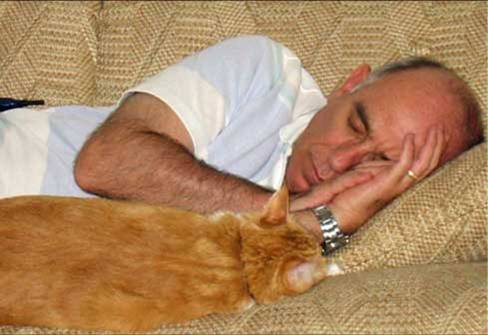 My
father and his cat Snoop are on the same medication for high blood pressure.
High stress can be a risk factor for high blood pressure in people,
as is smoking and drinking. My father definitely has more stress than
the cat does, but neither smoke or drink! So, what causes high blood
pressure in dogs and cats?
My
father and his cat Snoop are on the same medication for high blood pressure.
High stress can be a risk factor for high blood pressure in people,
as is smoking and drinking. My father definitely has more stress than
the cat does, but neither smoke or drink! So, what causes high blood
pressure in dogs and cats?
In dogs and cats, high blood pressure, also known as hypertension, is
almost always recognized as a complication of other diseases. In humans,
hypertension is often diagnosed as a primary problem – meaning, no underlying
disease is found.
A common cause of high blood pressure in animals is kidney disease.
The complication of hypertension develops in over half of cats with
kidney disease and in most dogs with kidney disease. As many cats develop
kidney disease as they age, monitoring for high blood pressure is important.
A diet lower in protein is recommended for animals with kidney disease.
A lower protein diet has been shown to slow the progression of kidney
disease. Diets made for kidney disease are often lower in salt, but
salt restriction is controversial as it does not appear to help control
high blood pressure in animals.
Snoop and my father could stand to lose a pound or two. Neither is obese.
But in any case, in dogs and cats there is no direct connection of obesity
to high blood pressure. Obesity can however lead to diabetes. Diabetes
is a risk factor for high blood pressure in both people and dogs. Diabetes
itself is not a risk factor for high blood pressure in cats.
Other diseases that lead to high blood pressure include Cushing’s disease
in dogs, and in cats an elevated thyroid level, or hyperthyroidism.
Low thyroid level in dogs, known as hypothyroidism, does not cause hypertension.
High blood pressure can cause sudden blindness, nose bleeds, or blood
clots that could lodge anywhere, including the brain. High blood pressure
may cause changes in personality. In cats, an increase in meowing, especially
at night, may be a sign of high blood pressure. People with hypertension
sometimes complain of early morning headaches, but this is a difficult
symptom to diagnose in an animal!
A blood pressure measurement is taken similarly to a human, by placing
an inflatable cuff on the leg or the tail. I like to allow an animal
to relax and calm down before blood pressure is taken. I always consider
how stressed an animal is when interpreting a blood pressure measurement.
Your pet should have an examination by your veterinarian every year
because early disease detection can increase the length and quality
of life. A blood test and urine test are recommended at least yearly
by age 7 in dogs and by age 10 in cats. High blood pressure is almost
always a complication of another disease, so your veterinarian may wait
to recommend a blood pressure measurement until your pet is diagnosed
with an illness. In patients with a high risk, a blood pressure measurement
should be taken routinely.